
Inventory Reconciliation: How Ecommerce Businesses Fix Stock Discrepancies
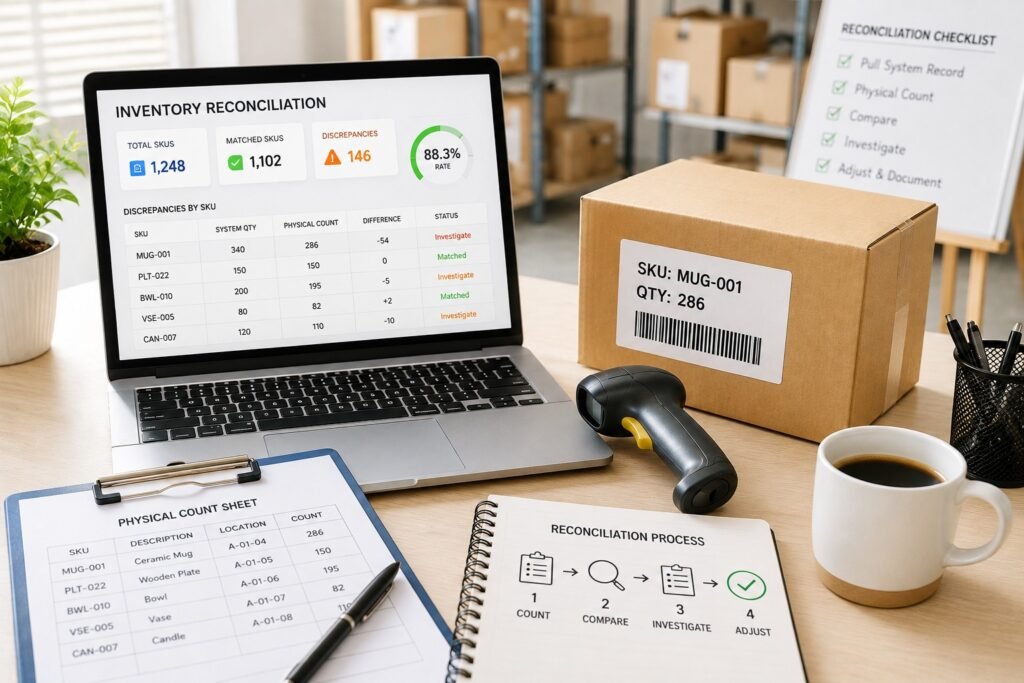
Every e-commerce operator eventually hits the same wall. The dashboard says 340 units of a bestselling SKU are sitting in the warehouse. The warehouse team walks the aisle and counts 286. Nobody remembers the last time those two numbers agreed, and now there’s a customer order that can’t ship. That gap between what your system believes and what’s physically on the shelf is exactly what inventory reconciliation exists to close. What Is Inventory Reconciliation? Inventory reconciliation is the process of comparing recorded stock levels against actual, physical stock and correcting the difference. It sounds almost too simple written out like that, but the mechanics get messy fast once you’re running multiple sales channels, a warehouse or two, and a return stream that never quite matches the outbound order stream. The point isn’t just “count things and fix numbers.” It’s building a repeatable check that catches drift before it turns into stockouts, overselling, or a warehouse full of phantom stock that exists only in a spreadsheet. For ecommerce specifically, the stakes are higher than a typical retail context because the system of record often has to sync across a storefront, a marketplace, a fulfillment partner, and sometimes a POS if there’s a physical retail arm too. Reconciliation is closely tied to broader inventory accounting practices it’s the quantity-accuracy layer that everything else, including COGS calculations and inventory valuation, depends on. If the quantities are wrong, the dollar figures built on top of them are wrong too. Common Methods for Inventory Reconciliation There isn’t one correct method. The right one depends on SKU volume, how fast stock moves, and how much risk a discrepancy actually creates for the business. None of these methods require touching valuation rules or costing methodology. Reconciliation is purely about quantity accuracy — not about how those units are priced on the books. How to Do Inventory Reconciliation: Step-by-Step Process Worked Example: Reconciling a Single SKU Say a mid-size home goods seller carries a ceramic mug that sells well on both Shopify and Amazon. Using the formula below: Reconciled Quantity = Physical Count − (System Recorded Quantity − Verified Adjustments) Reconciled Quantity = 286 − (340 − 6) = 286 − 334 = −48 A negative number here means physical stock is 48 units short of what the system — even after adjustments — says it should have. That’s the trigger to investigate before anyone touches the number: check recent receiving logs, look for a mis-pick during a large order, and confirm no damaged units were pulled without being logged. Only after the cause is identified does the system get corrected to 286. Physical Inventory Reconciliation on the Warehouse Floor Physical reconciliation is where the theory meets the actual aisle. A few things separate a clean count from a wasted afternoon: Smaller operations sometimes skip physical counts entirely once software promises real-time accuracy. That’s a mistake. Software reflects what’s been recorded, not what’s physically true. Damaged units that never got logged, mis-picked orders, and shrinkage all live in that blind spot, and only a physical count exposes them. Managing Inventory and Sales Reconciliation Together Stock and sales data have to reconcile with each other, not just with the warehouse. If your sales channel says 12 units sold today but only 9 units were deducted from stock, something in the order-to-inventory pipeline is broken — usually a sync delay between the storefront and the warehouse management system, or an order that got fulfilled outside the normal channel and never triggered a deduction. This is where a lot of ecommerce sellers get bitten. Sales and inventory reconciliation isn’t a once-a-month task the way physical counting can be; it needs a near-continuous check, because a broken sync compounds daily, and by the time month-end reconciliation catches it, you may have oversold dozens of units across multiple SKUs. For Shopify sellers specifically, this usually shows up as a mismatch between the Shopify inventory app and whatever accounting or Shopify bookkeeping system pulls from it worth checking first when the numbers won’t line up. Amazon Inventory Reconciliation Sellers using Fulfilled by Amazon (FBA) deal with a specific flavor of this problem. Amazon’s own inventory ledger, your internal system, and the physical units sitting in an Amazon fulfillment center can all show different numbers, and the causes are often outside your direct control: misplaced units inside Amazon’s network, receiving discrepancies at the fulfillment center, or reimbursement claims that were never filed for lost or damaged stock. Reconciling here means pulling Amazon’s inventory ledger report, comparing it against your internal system of record, and specifically checking for units marked “unfulfillable,” “lost,” or “damaged” that never had a corresponding reimbursement claim filed. Sellers who never audit this line item are, in practice, giving away inventory for free. Month-End Inventory Reconciliation Even with perpetual or cycle-based reconciliation running continuously, most ecommerce operations still anchor a full reconciliation to month end. It’s the checkpoint where every channel, every location, and every open discrepancy gets forced into agreement before reporting happens. Think of the ongoing cycle counts as the maintenance, and month-end as the audit that catches whatever slipped through. The Inventory Reconciliation Formula At its simplest: Reconciled Quantity = Physical Count − (System Recorded Quantity − Verified Adjustments) More usefully, accuracy is often tracked as a rate: Inventory Accuracy Rate = (Number of SKUs Matching Exactly ÷ Total SKUs Counted) × 100 Order reconciliation for accuracy purposes typically compares units sold against units deducted, flagging any SKU where the two diverge beyond a set threshold — commonly one to two percent — before it gets treated as a real problem rather than noise. Common Mistakes in Inventory Reconciliation Best Practices for Inventory Reconciliation How to Build a Sustainable Inventory Reconciliation Routine None of this works as a one-time project. The operators who stop losing money to phantom stock and overselling are the ones who treat reconciliation as a standing calendar item, assign clear ownership for investigating discrepancies, and actually act on the root-cause data instead of just