
Month-End Close Checklist for E-commerce Businesses
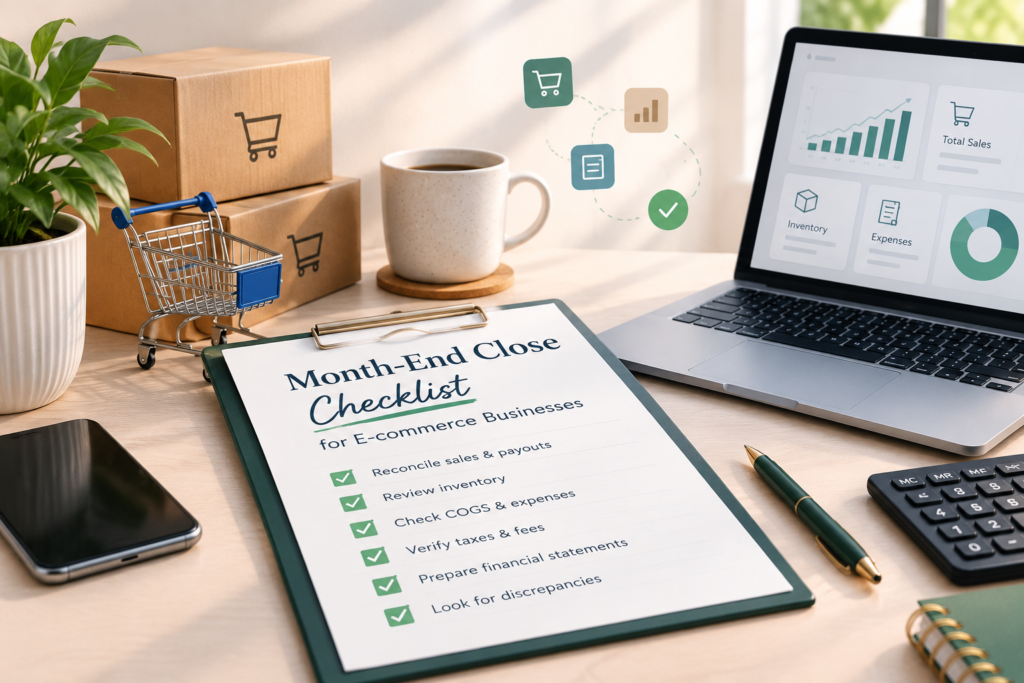
If your idea of month-end close is “reconcile the bank account and move on,” you’re doing about one step out of eighteen. A real close includes the full set of reconciliations, accruals, and reviews that turn a month of scattered transactions into financial statements you can trust and act on. For e-commerce sellers, that process looks meaningfully different from a standard small business close. Two things make it different. First, payout timing rarely lines up with when a sale actually happens. Second, inventory can exist in three places at once, on your shelf, in transit, and at a third-party warehouse, and all three need to agree with what your books say you own. Miss either one and your books can still balance perfectly while telling you the wrong story about how the business is actually doing. This month-end close checklist is built around that reality. For the broader day-to-day bookkeeping process, see our e-commerce bookkeeping checklist. It’s a working version of the process we use with e-commerce clients, laid out here so you can run it yourself or hand it to a bookkeeper as a repeatable SOP. Why Ecommerce Businesses Need a Different Month-End Close Under accrual accounting, revenue is recognized when it’s earned, generally when an order ships or a performance obligation is otherwise satisfied, not when the cash actually lands in your account. That distinction matters more for e-commerce sellers than most, because marketplaces and payment processors don’t pay out on the same schedule sales happen. Amazon, Shopify Payments, and similar processors typically hold funds for a period and disburse on their own rolling schedule, often net of fees, refunds, and any reserve they’re holding back. If your books only recognize revenue once a payout hits the bank, you’re effectively running on a cash basis without deciding to, and month-to-month comparisons stop being reliable because they’re really just tracking when money arrived rather than when it was earned. Inventory adds a second layer of complexity. Units on the shelf, units in transit from a manufacturer, and units sitting at a 3PL all need to reconcile against your accounting system’s inventory balance. A mismatch here does more than distort the balance sheet, it flows directly into cost of goods sold and can shift your margins in a direction you won’t notice until the gap has grown. Neither issue means close needs to be complicated. It means the checklist needs to include the right controls, not simply more of them. 18-Step Month-End Close Checklist for E-commerce Businesses 1. Set and communicate a cutoff date. Choose the exact date and time transactions stop counting for the month, and pull data from every channel, Shopify, Amazon, Walmart, and your payment processor, as of that same cutoff. Mismatched cutoffs across platforms are a common reason a close doesn’t tie out cleanly. 2. Reconcile every bank account. Match each transaction in your books against the corresponding bank statement for every operating, savings, or reserve account. 3. Reconcile credit card statements. Business credit cards get overlooked more often than bank accounts. Every charge should be categorized and matched, and any personal charges on a business card should be flagged rather than left sitting in a suspense account. 4. Reconcile marketplace and payment processor payouts. Match each payout deposit against the underlying sales, fees, refunds, and reserve holdbacks shown in the platform’s payout report, not just the total that hit your bank. This is where a large share of e-commerce close errors originate. 5. Record accrued revenue for sales not yet paid out. If an order was fulfilled during the month but the related payout arrives afterward, that revenue is generally recognized in the month it was earned under accrual accounting, with a corresponding receivable until cash is received. Skipping this step is a common reason e-commerce income statements look choppy from one month to the next. 6. Reconcile inventory quantities across all locations. Compare your inventory management system against a physical or cycle count, including stock at a 3PL and inventory in transit. Investigate variances before adjusting them away. 7. Update cost of goods sold. Once inventory is confirmed, make sure COGS reflects units actually sold during the month, valued under your chosen costing method (FIFO, LIFO, or weighted average), and includes landed costs like freight and duty rather than just the base vendor invoice price. 8. Review and adjust inventory reserves. If any inventory is slow-moving, damaged, or unlikely to sell at full price, check whether your obsolescence or shrinkage reserve still reflects current reality. 9. Record depreciation and amortization. Book the month’s depreciation on equipment, warehouse fixtures, or vehicles, and amortization on any capitalized software or intangible assets. 10. Accrue expenses incurred but not yet billed. This typically includes ad spend that ran but hasn’t been invoiced, contractor work completed but not yet paid, and freight or carrier charges that lag by a few weeks. These are recognized in the period incurred, regardless of when they’re actually paid. 11. Reconcile accounts payable. Confirm outstanding vendor bills match what suppliers show as owed, and check for anything double entered or missed entirely. 12. Reconcile accounts receivable. For sellers with wholesale, B2B, or net terms activity, confirm the aging schedule reflects what’s genuinely outstanding and flag anything moving into a higher-risk category. 13. Reconcile sales tax collected against sales tax remitted. This step is skipped more often than it should be. A small gap here compounds every month; it goes unchecked and can become a meaningful liability by year-end. 14. Review deferred revenue, if applicable. If you sell gift cards, subscriptions, or anything paid for in advance of delivery, confirm the deferred revenue balance still matches what hasn’t yet been fulfilled. 15. Review the returns and chargeback reserve. Estimate expected returns and chargebacks based on recent trends, and confirm the reserve on your books is reasonably close to that estimate rather than left at whatever number it was months ago. 16. Review payroll and contractor accruals. Confirm wages, payroll taxes, and contractor payments earned