
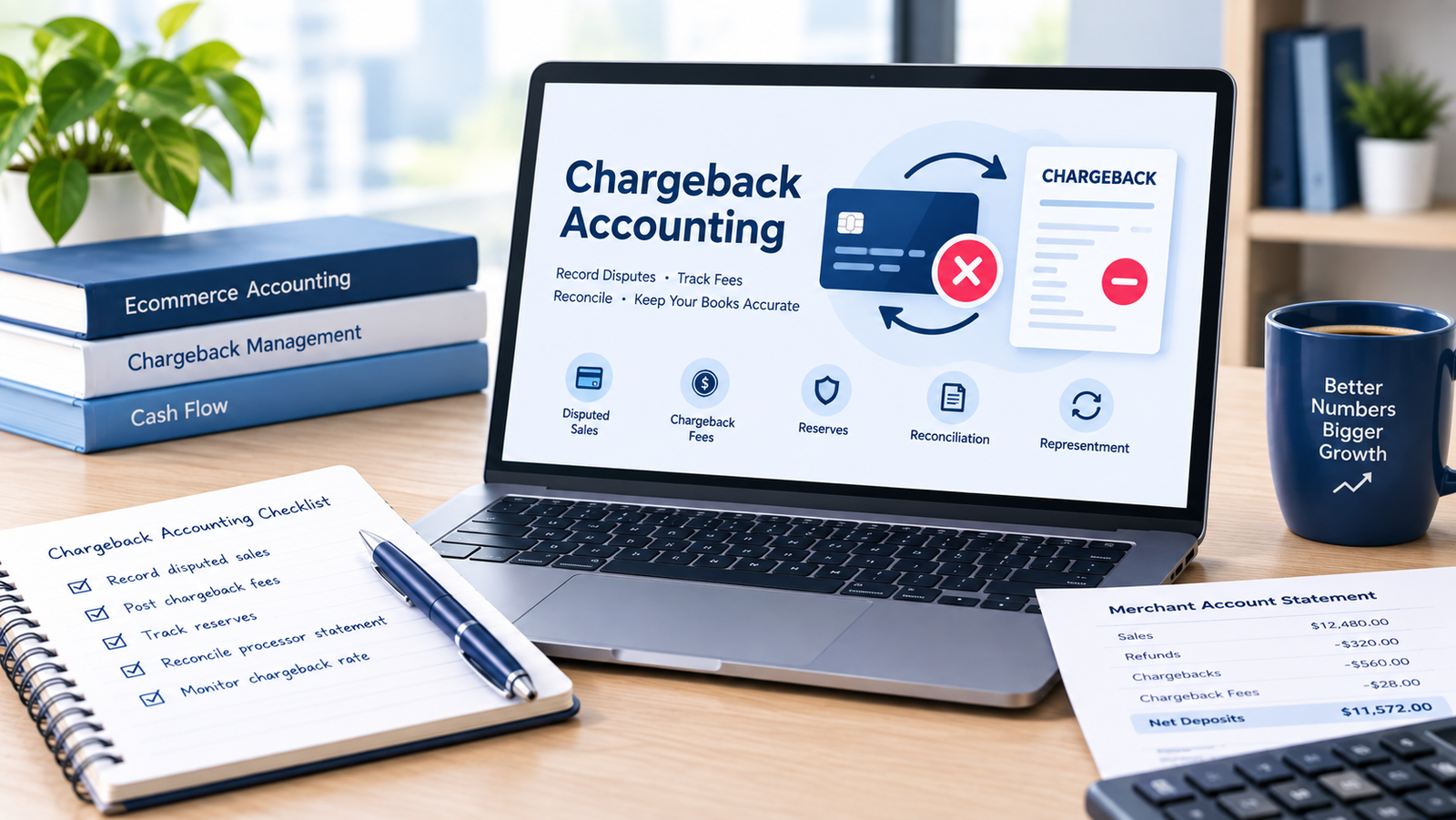
A chargeback shows up in your merchant account statement looking almost identical to a refund. It isn’t one, and treating it like one is probably the single most common mistake I see when reviewing an e-commerce client’s books for the first time.
A refund is something you initiate. A chargeback is something that happens to you. The customer disputes the charge directly with their card issuer, the disputed funds get pulled from your merchant account, and you’re typically notified after the reversal has already happened rather than asked in advance. That difference is exactly why refunds and chargebacks need separate accounting treatment, not a shared line item.
Chargeback vs. Refund: What’s the Accounting Difference?
| Refund | Chargeback | |
| Who initiates it | The merchant | The cardholder, through their bank |
| Fee attached | Usually none | Yes, charged by the processor regardless of outcome. |
| Merchant control | Full | Limited, unless contested through representation |
| Recorded as | Contra-revenue | Contra-revenue plus a separate fee expense |
| Reversible | Not applicable | Yes, if the merchant wins representment |
If a chargeback is being recorded as a plain refund in your books, two things are happening quietly. Your dispute-related costs are understated, and you’ve lost the ability to see your actual chargeback rate as its own number instead of a figure buried inside a blended returns account.
Chargeback Accounting vs. Management: What’s the Difference?
These two terms get used almost interchangeably, and that’s part of why the accounting side often gets neglected. Chargeback management is operational: fraud screening, clear product descriptions, responsive customer service, and accurate tracking information, all aimed at reducing how many disputes happen in the first place. Chargeback accounting is the separate discipline of recording, reconciling, and reporting the disputes that do occur, regardless of whether your management practices are strong or weak.
A business can have excellent chargeback management and still have poor chargeback accounting, usually because the bookkeeping habit of lumping disputes into general returns formed early and never got revisited. The two need to work together, but fixing one doesn’t fix the other.
How to Record a Chargeback in Ecommerce Accounting
A chargeback typically triggers two separate financial events, and the entries should reflect both rather than netting them into one line.
First, the disputed sale gets reversed. This reduces revenue the same way a return would, and for most ecommerce businesses the offsetting side is Cash or a payment processor clearing account, not Accounts Receivable, since card sales are rarely invoiced. Accounts Receivable becomes relevant mainly for B2B or ACH based transactions where a formal receivable existed.
A typical entry, assuming the processor deducts the amount directly from your payout:
Debit: Chargebacks (a dedicated contra revenue account, separate from general Sales Returns and Allowances) — transaction amount Credit: Cash or Merchant Clearing Account — transaction amount
Second, a chargeback fee is charged by the processor, independent of the disputed amount and independent of whether you eventually win the dispute.
Debit: Chargeback Fees Expense — fee amount Credit: Cash or Merchant Clearing Account—fee amount
Keeping chargebacks in their own contra revenue account rather than folding them into general returns costs nothing to set up and means your chargeback rate is visible on demand instead of something you have to reconstruct at year end.
Chargeback Fees: Where They Belong on the P&L
The disputed transaction amount belongs in contra revenue, reducing net sales. The chargeback fee is a separate cost of doing business and belongs in operating expenses, usually grouped with payment processing or merchant fees rather than mixed into the revenue reversal itself. The disputed transaction amount belongs in contra revenue, reducing net sales, while the chargeback fee is a separate operating expense. This distinction matters when reviewing your e-commerce P&L.
Processor fee amounts vary meaningfully by platform, card network, and your account’s risk history, and the specific dollar figure charged by Stripe, Shopify Payments, or PayPal should be confirmed directly against your own processor agreement rather than assumed. What matters for your books is the separation: one number tells you how much revenue was lost, the other tells you what it cost you to have the dispute happen at all. Collapsing both into a single expense line understates gross margin in a specific way. It makes the cost of doing business look higher than it is while masking a revenue quality problem that’s actually driving the trend.
Reserves and Chargeback Allowances: Two Different Things
This is where I see the most confusion, and it’s worth separating clearly.
A processor holdback or rolling reserve is cash your payment processor withholds from your payout in anticipation of future disputes. It is still your asset. It belongs on the balance sheet, typically as a restricted cash asset or a receivable from the processor, not as an expense. I’ve seen founders write off a growing reserve balance because it feels like lost money, when it’s actually sitting with the processor waiting to be released once the risk period passes.
A chargeback allowance is a different concept entirely, relevant mainly to businesses on accrual basis accounting with a meaningful and fairly predictable dispute rate. Similar to an allowance for doubtful accounts, it’s an estimated contra revenue reserve booked at period end based on historical chargeback patterns, intended to match anticipated future disputes against the revenue that generated them. Most small ecommerce sellers don’t need this level of accrual sophistication, but it becomes relevant once dispute volume is material enough to distort period-over-period revenue comparisons, or once a lender or investor expects GAAP aligned reporting.
Chargebacks and Cash Flow
Because a chargeback pulls cash after the original sale was recorded, and often after inventory is already shipped, it creates a timing gap between reported revenue and actual cash collected. Revenue gets recognized in one period. The reversal can land weeks later, sometimes crossing into the next reporting period entirely.
For a business with a climbing chargeback rate, this shows up as operating cash flow that consistently lags behind net income. That gap isn’t always an inventory timing issue, and it’s worth checking chargeback activity specifically before assuming the cause is something else.
Reconciling Chargebacks Against Your Processor Statement
Monthly reconciliation is where most of the real mess gets caught. Your accounting system and your payment processor rarely present chargebacks identically in real time, and Shopify Payments, Stripe, and PayPal each report disputes with slightly different terminology and timing.
A workable process: pull the dispute report directly from each processor you use, match each entry against what’s recorded in your books, and pay particular attention to chargebacks that were reported by the processor in one month but recorded internally in another, since that lag is the most common source of a reconciliation gap. Left unaddressed for a few months, this kind of mismatch is exactly the type of finding that turns into a flagged discrepancy during a closer financial review.
Chargeback Representation: What Actually Happens When You Win
Representment is the formal process of contesting a chargeback by submitting evidence, such as delivery confirmation or customer communication, to the card network. Winning a representment case reverses the original chargeback and returns the disputed funds. It does not, in most cases, refund the chargeback fee itself, which is generally treated by processors as a cost of processing the dispute rather than a penalty tied to the outcome. Confirm this specifically with your own processor, since policies differ.
When funds are returned through successful representment:
Debit: Cash or Merchant Clearing Account — transaction amount Credit: Chargebacks (contra revenue account) — transaction amount
The fee stays recorded as an expense regardless of outcome, since it was already incurred. Tracking win versus loss rates by dispute reason code is worth doing even informally. It’s useful operational data, and it’s exactly the kind of detail that becomes relevant if disputes ever grow into a notable line item worth explaining to a buyer or lender.
Chargeback Rate: Why It Matters More Than the Dollar Total
Card networks monitor chargeback rate, calculated as total chargebacks divided by total transactions over a defined period, and each network runs its own monitoring program with its own thresholds. Visa and Mastercard both maintain dispute monitoring programs with tiered thresholds that can trigger additional fees or account review once exceeded, and the specific percentage varies by program tier and network, generally sitting somewhere under two percent depending on which program and threshold applies. Rather than treating any single percentage as a universal rule, check your processor’s current published guidelines, since these programs get updated periodically.
What’s consistent across networks is the underlying risk: exceeding a monitoring threshold repeatedly can result in additional monitoring fees or, in more serious cases, put continued processing access at risk regardless of how small the dollar amounts involved appear on paper.
Chargeback reduction, as distinct from chargeback accounting, is largely an operational effort rather than a bookkeeping one. Clear product descriptions, responsive customer service, and accurate order tracking all measurably reduce dispute volume over time. The accounting discipline covered here doesn’t reduce chargebacks directly, but it’s what makes it possible to actually see whether your reduction efforts are working.
Why This Matters Beyond Clean Books
A chargeback rate that’s climbing, poorly tracked, or buried inside a generic returns account tends to surface eventually, usually at the worst possible time, whether that’s a bank reviewing your merchant account or a buyer’s financial reviewer questioning revenue durability. Getting the accounting treatment right isn’t only about tidier books this month. It’s about being able to answer, with actual numbers, exactly how disputes are trending and what they’re costing, rather than discovering the answer under pressure.