
Most e-commerce founders do not fail because they lack sales. They fail because the money moves differently than they expected it to, and by the time they notice, the gap is already three months wide. Financial forecasting is the discipline that closes that gap before it opens, and a budget forecast is the specific tool that turns a vague sense of “we should be fine” into a number you can actually plan against.
This guide walks through what e-commerce financial forecasting really involves, how it differs from a plain budget, and a repeatable process for building a budget forecast that survives contact with a real sales channel, real returns, and a real payout schedule.
What Ecommerce Financial Forecasting Actually Means
Financial forecasting is the process of predicting a company’s future revenue, costs, and cash position using historical performance, known assumptions, and market signals. In an e-commerce context, that means something more specific than the generic definition suggests.
A software company forecasts subscription revenue that renews on a predictable schedule. An e-commerce business forecasts a business where revenue depends on traffic, conversion rate, average order value, channel mix, and a seasonality curve that can swing thirty or forty percent between a slow month and Black Friday week. Costs are equally uneven: inventory has to be purchased and paid for weeks or months before it sells, marketing spend can be turned up or down almost daily, and payment processors hold funds on their own schedule rather than yours.
That last point trips up more founders than any other. Shopify Payments typically settles within one to three business days, but Amazon pays out roughly every two weeks, and some marketplaces run on a thirty-day cycle. If your budget forecast assumes revenue equals cash the moment a sale happens, your bank balance will consistently disagree with your spreadsheet, and that disagreement compounds every month you leave it unmodeled.
Budget vs Forecast: A Distinction Worth Getting Right
These two words get used interchangeably, and that habit causes real damage.
A budget is a plan. It is the number you set at the start of a period, usually a quarter or a year, based on your goals and available resources. A forecast is a prediction. It updates continuously as new information arrives, and its entire job is to reflect reality as closely as possible, even when reality contradicts the original plan.
The practical implication: your December budget might say you will spend eighty thousand dollars on paid ads. Your November forecast, built from actual October performance, might tell you that eighty thousand will only produce sixty percent of the sales you were counting on because your blended CAC has crept up. A healthy ecommerce finance process uses the forecast to decide whether to hold the budget, cut it, or reallocate it, rather than defending a number that was accurate the day you wrote it and stale two months later.
The Core Inputs Every Ecommerce Forecast Needs
A forecast is only as good as its assumptions, and vague assumptions are where most spreadsheets quietly go wrong. Six inputs carry almost all the weight.
Historical sales data. Pull at least twelve to eighteen months so seasonality shows up clearly rather than looking like random noise. A single strong month can look like a trend if you only have three months to compare it against.
Channel mix. Website, Amazon, retail wholesale, and marketplace sales each carry different margins, different payout timing, and different fee structures. Blending them into one revenue line hides where the actual profit sits.
Average order value and conversion rate. These two numbers, multiplied by projected traffic, produce your revenue forecast. Small movements compound quickly. A five percent AOV increase from a bundling strategy behaves very differently in the model than a five percent traffic increase, even though both look similar on the top line.
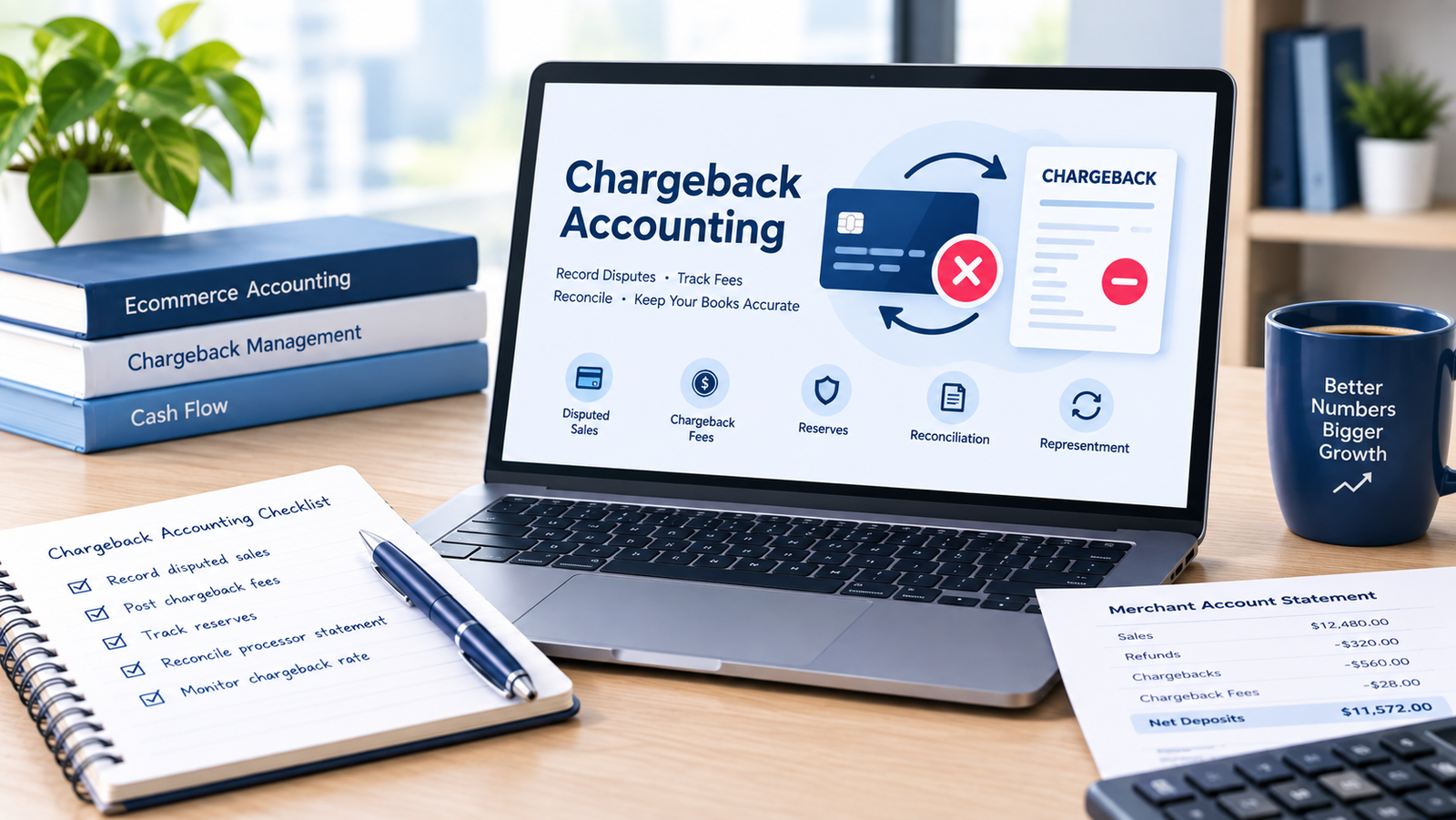
Return and chargeback rate. Apparel businesses routinely see return rates above twenty percent. If your forecast books gross revenue without netting this out, projected cash will overstate reality every single month, and the error grows during high-return categories like holiday gifting.
Cost of goods sold and freight. COGS as a percentage of revenue should be tracked by product line, not averaged across the whole catalog, because a shift in your bestseller mix can quietly compress margin even while revenue climbs.
Marketing spend and CAC. Rather than budgeting marketing as a flat percentage of revenue, tie it to customer acquisition cost payback. If your CAC payback period is running past six months, that is a signal to slow spend before the cash strain shows up elsewhere.
Building the Budget Forecast: A Working Process
Step 1: Choose your forecasting method
Two approaches dominate e-commerce. A top-down forecast starts with a total revenue target and works backward into channel and product assumptions, useful for a founder setting an ambitious growth goal. A bottom-up forecast starts with unit-level drivers, traffic times, conversion times, and AOV by channel and builds up to a total. Bottom-up is slower to construct but far more defensible when you need to explain a variance to a lender, investor, or your own team.
Step 2: Build the revenue layer first
Segment revenue by channel and, where possible, by product category. Apply your historical seasonality index to each segment rather than to the total, since a wholesale account and a Black Friday DTC spike do not move together.
Step 3: Layer in cost drivers against revenue, not against time
COGS and shipping should scale with units sold, not sit as a flat monthly number. Fixed costs like software subscriptions and salaries stay flat and get modeled separately so a founder can see, at a glance, how much revenue is required to cover fixed overhead before any profit exists.
Step 4: Model cash separately from revenue
This is the step most templates skip, and it is the one that prevents surprises. Apply your actual payout timing per channel, subtract expected returns and chargebacks, and lay the result against your accounts payable schedule for inventory. The output is a cash forecast that can diverge meaningfully from the revenue forecast, especially in the weeks after a big inventory purchase or a major promotional push.
Step 5: Build three scenarios, not one
A single number invites false confidence. Build a base case using your most likely assumptions, an upside case that tests what happens if a channel outperforms, and a downside case that tests a slower quarter or a rising return rate. The downside case is usually the one that reveals whether you actually have enough working capital to survive a rough stretch.
Step 6: Review monthly and reforecast
Compare actuals against the forecast every month, not every quarter. Note where the variance came from, whether it was a traffic miss, a margin shift, or a timing issue, and roll an updated forecast forward. Over a year, this turns a static document into a genuinely useful decision tool.
Common Mistakes That Undermine an Ecommerce Forecast
Founders rarely get the concept wrong. They get the details wrong, and the details are where accuracy lives.
Treating gross revenue as spendable cash is probably the single most common error, since it ignores processor fees, returns, and payout lag all at once. Averaging seasonality across the whole business instead of by channel is another, because a wholesale account with flat monthly demand can mask a DTC channel that swings wildly. Setting marketing budget as a fixed percentage of revenue, regardless of what CAC is actually doing, is a third, and it is often the one that quietly erodes profitability the longest before anyone notices.
The fix for all three is the same habit: build the forecast from real drivers, check it against actuals monthly, and treat every assumption as something to be tested rather than something to be trusted.
Bringing It Together
Ecommerce financial forecasting is not a once-a-year exercise you complete before a board meeting or a loan application. It is closer to a monthly operating rhythm, one that connects sales data, channel payout timing, cost of goods, and marketing efficiency into a single working picture of where the business is actually headed. A budget sets the intention. A forecast tells you, honestly and continuously, whether that intention still matches reality and gives you the lead time to adjust before a shortfall becomes a crisis.
Get the six core inputs right, separate cash from revenue, and build the habit of reforecasting monthly, and the forecast stops being a compliance exercise and starts becoming the tool that actually runs the business.