
Inventory Reconciliation: How Ecommerce Businesses Fix Stock Discrepancies
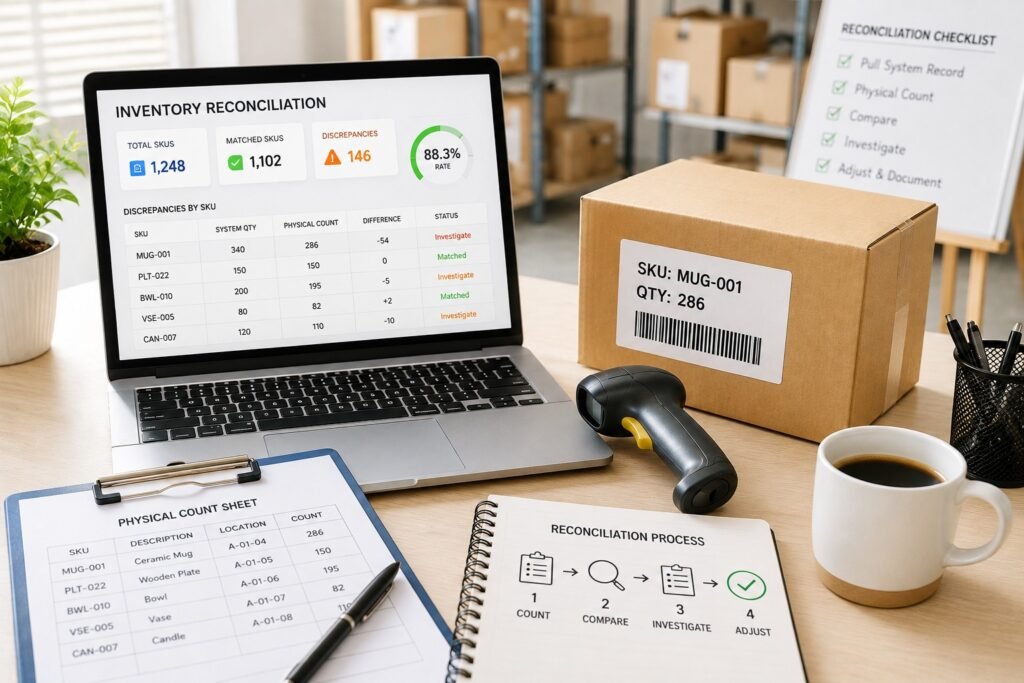
Every e-commerce operator eventually hits the same wall. The dashboard says 340 units of a bestselling SKU are sitting in the warehouse. The warehouse team walks the aisle and counts 286. Nobody remembers the last time those two numbers agreed, and now there’s a customer order that can’t ship. That gap between what your system believes and what’s physically on the shelf is exactly what inventory reconciliation exists to close. What Is Inventory Reconciliation? Inventory reconciliation is the process of comparing recorded stock levels against actual, physical stock and correcting the difference. It sounds almost too simple written out like that, but the mechanics get messy fast once you’re running multiple sales channels, a warehouse or two, and a return stream that never quite matches the outbound order stream. The point isn’t just “count things and fix numbers.” It’s building a repeatable check that catches drift before it turns into stockouts, overselling, or a warehouse full of phantom stock that exists only in a spreadsheet. For ecommerce specifically, the stakes are higher than a typical retail context because the system of record often has to sync across a storefront, a marketplace, a fulfillment partner, and sometimes a POS if there’s a physical retail arm too. Reconciliation is closely tied to broader inventory accounting practices it’s the quantity-accuracy layer that everything else, including COGS calculations and inventory valuation, depends on. If the quantities are wrong, the dollar figures built on top of them are wrong too. Common Methods for Inventory Reconciliation There isn’t one correct method. The right one depends on SKU volume, how fast stock moves, and how much risk a discrepancy actually creates for the business. None of these methods require touching valuation rules or costing methodology. Reconciliation is purely about quantity accuracy — not about how those units are priced on the books. How to Do Inventory Reconciliation: Step-by-Step Process Worked Example: Reconciling a Single SKU Say a mid-size home goods seller carries a ceramic mug that sells well on both Shopify and Amazon. Using the formula below: Reconciled Quantity = Physical Count − (System Recorded Quantity − Verified Adjustments) Reconciled Quantity = 286 − (340 − 6) = 286 − 334 = −48 A negative number here means physical stock is 48 units short of what the system — even after adjustments — says it should have. That’s the trigger to investigate before anyone touches the number: check recent receiving logs, look for a mis-pick during a large order, and confirm no damaged units were pulled without being logged. Only after the cause is identified does the system get corrected to 286. Physical Inventory Reconciliation on the Warehouse Floor Physical reconciliation is where the theory meets the actual aisle. A few things separate a clean count from a wasted afternoon: Smaller operations sometimes skip physical counts entirely once software promises real-time accuracy. That’s a mistake. Software reflects what’s been recorded, not what’s physically true. Damaged units that never got logged, mis-picked orders, and shrinkage all live in that blind spot, and only a physical count exposes them. Managing Inventory and Sales Reconciliation Together Stock and sales data have to reconcile with each other, not just with the warehouse. If your sales channel says 12 units sold today but only 9 units were deducted from stock, something in the order-to-inventory pipeline is broken — usually a sync delay between the storefront and the warehouse management system, or an order that got fulfilled outside the normal channel and never triggered a deduction. This is where a lot of ecommerce sellers get bitten. Sales and inventory reconciliation isn’t a once-a-month task the way physical counting can be; it needs a near-continuous check, because a broken sync compounds daily, and by the time month-end reconciliation catches it, you may have oversold dozens of units across multiple SKUs. For Shopify sellers specifically, this usually shows up as a mismatch between the Shopify inventory app and whatever accounting or Shopify bookkeeping system pulls from it worth checking first when the numbers won’t line up. Amazon Inventory Reconciliation Sellers using Fulfilled by Amazon (FBA) deal with a specific flavor of this problem. Amazon’s own inventory ledger, your internal system, and the physical units sitting in an Amazon fulfillment center can all show different numbers, and the causes are often outside your direct control: misplaced units inside Amazon’s network, receiving discrepancies at the fulfillment center, or reimbursement claims that were never filed for lost or damaged stock. Reconciling here means pulling Amazon’s inventory ledger report, comparing it against your internal system of record, and specifically checking for units marked “unfulfillable,” “lost,” or “damaged” that never had a corresponding reimbursement claim filed. Sellers who never audit this line item are, in practice, giving away inventory for free. Month-End Inventory Reconciliation Even with perpetual or cycle-based reconciliation running continuously, most ecommerce operations still anchor a full reconciliation to month end. It’s the checkpoint where every channel, every location, and every open discrepancy gets forced into agreement before reporting happens. Think of the ongoing cycle counts as the maintenance, and month-end as the audit that catches whatever slipped through. The Inventory Reconciliation Formula At its simplest: Reconciled Quantity = Physical Count − (System Recorded Quantity − Verified Adjustments) More usefully, accuracy is often tracked as a rate: Inventory Accuracy Rate = (Number of SKUs Matching Exactly ÷ Total SKUs Counted) × 100 Order reconciliation for accuracy purposes typically compares units sold against units deducted, flagging any SKU where the two diverge beyond a set threshold — commonly one to two percent — before it gets treated as a real problem rather than noise. Common Mistakes in Inventory Reconciliation Best Practices for Inventory Reconciliation How to Build a Sustainable Inventory Reconciliation Routine None of this works as a one-time project. The operators who stop losing money to phantom stock and overselling are the ones who treat reconciliation as a standing calendar item, assign clear ownership for investigating discrepancies, and actually act on the root-cause data instead of just
The Ecommerce Bookkeeping Checklist Every Store Owner Needs

Most e-commerce bookkeeping problems don’t start as bookkeeping problems. They start as a task that gets pushed to “next week” three or four times in a row until next week becomes four months ago and nobody’s entirely sure what happened to a chunk of Q2’s refunds. A checklist doesn’t fix that on its own. What it does is give you a rhythm, something to come back to on a schedule that matches how e-commerce transactions actually move, rather than a vague sense that you should “stay on top of the books” without a clear picture of what that means week to week. I’ve built this around four cadences, because treating bookkeeping as one undifferentiated pile of tasks is exactly how things start slipping. Some of this needs daily attention. Some of it only matters once a year. Knowing which is which is most of the battle. Daily and Weekly Tasks These are the small, low-effort habits that prevent the bigger monthly tasks from turning into archaeology. Review new orders and payment deposits. Not a deep audit, just a glance to confirm payouts from Shopify, Amazon, or your payment processor are landing as expected and nothing looks obviously wrong, like a payout that’s noticeably smaller than the sales volume would suggest. Log any manual expenses. Ad spend adjustments, one-off software purchases, anything that didn’t come through an automated bank feed. These are the transactions most likely to get forgotten entirely if they’re not captured close to when they happen. Flag refunds and chargebacks as they occur. You don’t need to process them fully every single day, but noting them somewhere prevents a surprise pile of unreconciled refund activity at month end. Monthly Tasks This is where the real bookkeeping work happens, and it’s the cadence most sellers either do inconsistently or skip during busy months, which is exactly when skipping it causes the most damage. Reconcile every bank account and payment processor. Match your recorded transactions against actual bank and platform statements. This is the single task that catches duplicate entries, missing deposits, and fee changes before they compound into something harder to untangle. If you’re running multiple channels, this needs to happen for each one, not just your primary bank account. Review and categorize all transactions. Every expense should land in the right chart of accounts category. Merchant fees, shipping costs, advertising spend, and cost of goods sold should never blend together into a single “miscellaneous” bucket, since that’s where profitability visibility disappears. Update inventory and COGS. Confirm inventory purchases during the month are properly reflected and that cost of goods sold is being recognized against units actually sold, not simply against inventory purchased. This is one of the more common e-commerce-specific errors, and it’s worth double-checking monthly rather than assuming your software handles it correctly by default. Review accounts receivable and payable. Less relevant for a pure direct-to-consumer store, more relevant if you also do any wholesale or B2B selling alongside your main channel. Generate and actually read your profit and loss statement. Not just generate it and file it away. Read it, compare it against the prior month, and notice anything that doesn’t match your intuition about how the month went. Quarterly Tasks File and remit sales tax. Deadlines and thresholds vary by state, and multistate economic nexus obligations catch a lot of growing sellers off guard. If you’ve crossed a sales threshold in a new state this quarter, that’s worth confirming rather than assuming last quarter’s filing list still applies. Review estimated tax payments. If your business structure requires quarterly estimated payments, this is the point to reassess based on how the year is actually trending, not just the number you estimated back in January. Run a deeper reconciliation pass. Beyond the monthly transaction level check, a quarterly review catches slower-moving issues, things like a subscription that renewed at a different price point than expected or a fee structure change from your payment processor that only becomes obvious once you look at a few months side by side. Year End Checklist This is where most of the anxiety in this search topic actually lives, and for good reason, since the consequences of missing something here are more expensive than at any other point in the cycle. Reconcile the full year, not just the final month. Confirm every month’s reconciliation actually happened and wasn’t skipped during a busy stretch. This is the point to go back and close any gaps. Conduct a physical or system-based inventory count. Your recorded inventory value needs to match what you actually have on hand or be reasonably close to it. Discrepancies here directly affect your cost of goods sold and your reported profit. Gather 1099 documentation. Payment processors will issue 1099-K forms based on transaction volume, and you’ll need to reconcile those figures against your own recorded revenue rather than assuming they’ll match perfectly, since processor reporting periods don’t always align cleanly with a calendar year. Review your chart of accounts for the year. Confirm nothing got miscategorized in a way that would distort your annual financial statements, and clean up any accounts that accumulated inconsistent naming over the months. Confirm your inventory valuation method was applied consistently. Whether you’re using FIFO, LIFO, or weighted average cost, the method needs to have been applied the same way across the entire year, not adjusted informally partway through. Prepare final financial statements. Your annual profit and loss statement and balance sheet should be finalized and reviewed before handing anything to a tax preparer, not generated for the first time the week taxes are due. Shopify and Amazon Specific Considerations Shopify sellers should pay particular attention to how payout batching bundles fees, refunds, and reserves into a single deposit figure, which is one of the more common sources of monthly reconciliation confusion. Amazon sellers have an added layer, since settlement periods don’t align neatly with calendar months, and reserve holdbacks can make a given period’s payout look smaller than the actual sales activity would
Why Ecommerce Businesses Use the FIFO Inventory Method

Picture this. Your Q4 revenue looks strong, orders are climbing across Shopify and Amazon FBA, and then your bookkeeper sends over a margin report that makes no sense. Profit looks thinner than it should, and two warehouses selling the exact same product somehow show different costs. Nine times out of ten, the problem is not sales. It is how the inventory is being costed. This is exactly where the FIFO inventory method earns its keep. FIFO decides which costs get pulled into cost of goods sold first, and that single decision ripples into your gross margin, your taxable income, and how trustworthy your balance sheet looks to a lender or investor reviewing your books. Get it wrong, and COGS, profit margins, and your tax bill all quietly drift out of alignment together. Before untangling that mess, it helps to understand what FIFO actually means and why it behaves the way it does. What FIFO Actually Means FIFO inventory costing method assigns the cost of your oldest purchased or manufactured units to the goods you sell first, regardless of which physical box actually left the shelf. That distinction matters. FIFO is an accounting assumption about cost flow, not a warehouse picking policy. A brand can physically ship whatever unit is closest to the loading dock and still report FIFO in its books, as long as the cost layers are tracked in that order. Under the FIFO method of inventory valuation, your ending inventory on the balance sheet ends up valued closer to your most recent purchase costs, since the older, often cheaper, costs have already been pulled into cost of goods sold. That single mechanic explains most of why ecommerce brands prefer it. A Worked Example Say a home goods brand buys ceramic mugs in three batches over a quarter: Batch Units Cost per unit Total cost January 500 $4.00 $2,000 February 500 $4.50 $2,250 March 500 $5.00 $2,500 The brand sells 900 units during the quarter. Under FIFO, the first 500 units sold are costed from the January batch, and the next 400 units come from the February batch. COGS = (500 x $4.00) + (400 x $4.50) = $2,000 + $1,800 = $3,800 Ending inventory = 100 remaining February units + 500 March units = (100 x $4.50) + (500 x $5.00) = $450 + $2,500 = $2,950 That ending inventory figure of $2,950 sits close to current replacement cost, which is exactly why lenders and investors tend to trust FIFO based balance sheets more readily than other methods during a period of rising costs. Why Ecommerce Brands Specifically Lean on FIFO Three reasons show up again and again when you talk to actual operators rather than textbooks. First, physical stock rotation. Apparel, beauty, food adjacent, and supplement brands are dealing with expiration dates, seasonal styles, or packaging refreshes. Selling the oldest stock first is not just an accounting preference, it is operational common sense, and FIFO happens to mirror that reality. Second, cleaner financial statements during inflation. When your supplier costs are climbing, which has been the norm for most product categories over the last several years, FIFO pulls the cheaper, older costs into COGS first. That produces a lower COGS figure and a higher reported gross margin compared to LIFO or weighted average in the same period. For a brand raising a round, applying for a line of credit, or preparing for acquisition due diligence, that cleaner looking margin story genuinely matters. Third, simplicity for growing teams. FIFO is intuitive enough that a bookkeeper without a deep accounting background can apply it correctly, and most ecommerce platforms and inventory tools default to it or support it natively, which is not always true for LIFO. The tradeoff worth naming honestly: that same inflation era margin boost usually means a higher taxable income and a bigger tax bill compared to LIFO, since fewer of the pricier recent costs get expensed. Brands sometimes discover this the hard way in their second or third profitable year. FIFO Periodic vs FIFO Perpetual This is where a lot of the online explanations get vague, so it is worth being precise. The FIFO periodic inventory method calculates COGS and ending inventory at set intervals, typically month end or quarter end, using a physical count. You are not tracking cost layer by cost layer in real time. This can work for smaller catalogs with low sales velocity, but it breaks down fast once you are selling across multiple channels daily. The FIFO perpetual inventory method updates COGS and inventory value after every single sale, in real time, as each transaction happens. Nearly every modern ecommerce operation ends up here by necessity, because platforms like Shopify, inventory management software, and 3PL systems are already logging transactions continuously. Trying to bolt a periodic method onto that data flow just creates reconciliation headaches later. For a deeper side by side breakdown of when each version genuinely makes sense, see our full comparison of the periodic and perpetual approaches. FIFO vs LIFO vs Weighted Average, Briefly Method COGS during rising costs Ending inventory value Common in ecommerce FIFO Lower Closer to current cost Very common LIFO Higher Understated vs current cost Rare, mostly excluded under IFRS Weighted average Smooths between the two Blended Common for commodity style bulk goods We cover the full LIFO comparison, including the IRS conformity rule that restricts mixing LIFO for tax purposes with a different method for your books, in a dedicated article. Implementing FIFO Across a Real Ecommerce Stack This is the part most guides skip entirely, and it is where things actually go wrong for growing brands. If you sell on Shopify, fulfill through a 3PL, and also move inventory through Amazon FBA, you have three different systems each with their own view of what left the warehouse and when. None of them automatically agree with each other on cost layers unless someone is actively reconciling them. A few things that consistently trip up otherwise well run brands: We walk through
Inventory Accounting for Ecommerce: Methods, Journal Entries and Best Practices

If you sell physical products, inventory is probably the single largest number sitting on your balance sheet, and it is also the number most likely to be wrong. Not because anyone is careless, but because inventory touches almost every part of the business at once: purchasing, warehousing, fulfillment, returns, and eventually the tax return. Inventory accounting is the discipline that ties all of that activity back to a single, defensible dollar figure. What Is Inventory Accounting Inventory accounting is the set of rules and practices a business uses to record the cost of goods it buys or produces, track how that cost moves through the balance sheet, and recognize the right expense at the right time once those goods are sold. In plain terms, it answers two questions every accounting period: How much is our unsold stock worth right now, and how much did it cost us to earn the revenue we booked this month? When people search for the definition, they are usually also asking a related question that rarely gets a straight answer: merchandise inventory is what type of account? Merchandise inventory is a current asset. It sits on the balance sheet, not the income statement, until the moment a unit sells. At that point, its cost moves out of inventory and into cost of goods sold, which is an expense account. That single movement, from asset to expense, is the engine behind almost every inventory accounting entry you will ever make. Why Inventory Accounting Matters for Ecommerce Businesses A consultant’s biggest asset is time already billed. A seller’s biggest asset is a warehouse (or a 3PL pallet, or an Amazon FBA bin) full of product that has not sold yet. That difference changes everything about how the books need to work. Multichannel selling makes it worse in a specific way. The same SKU might sell on Shopify, Amazon, and a wholesale account simultaneously, and each channel has its own fee structure, return rate, and fulfillment cost. If your inventory accounting does not consolidate all three channels against one true unit cost, your margin reporting will be wrong even if every individual sale was recorded correctly. This is one of the most common blind spots I see in growing e-commerce brands, and it usually only gets fixed once a controller sits down and reconciles the general ledger against actual unit economics. Where Does Inventory Appear in Accounting? Inventory generally falls into three categories once you get past a straightforward resale business: raw materials, work in process, and finished goods. Most e-commerce sellers only deal with finished goods, since they are reselling or lightly assembling product rather than manufacturing from scratch. Regardless of category, inventory sits on the balance sheet as a current asset, valued at the lower of its recorded cost or its net realizable value under GAAP. That “lower of” clause matters more than most sellers realize because it is the legal basis for writing down inventory that has lost value, which we cover in the reserve section below. Inventory Accounting Methods, Briefly There are four widely used inventory accounting methods, and the one you choose changes your reported profit, your tax bill, and your balance sheet, even though the physical goods never change hands differently. Most small e-commerce sellers land on FIFO or weighted average because they sell fungible product that do not need unit-level tracking. Inventory Reserve Accounting An inventory reserve is a contra asset account that reduces the reported value of inventory to reflect stock that has lost value through obsolescence, damage, or slow turnover. It is a conservative accounting practice, and for e-commerce brands carrying seasonal or trend-driven products, it is not optional in any meaningful sense. If you are still selling last year’s product at a steep discount and your books still show it at full original cost, your balance sheet is overstating what you actually own. The basic entry debits an expense account, often called an inventory write-down expense, and credits the reserve account, which lives just below inventory on the balance sheet as a contra asset. When the goods are eventually disposed of or sold at the discounted price, the reserve absorbs the loss instead of hitting cost of goods sold a second time. Consignment Inventory Accounting Consignment changes the ordinary rule that inventory belongs to whoever holds it. Under a consignment arrangement, the consignor (the owner) keeps the inventory on their own books even though the consignee (often a retail partner) physically holds and displays it. Revenue is not recognized until the consignee actually sells the goods to an end customer, at which point the consignor records the sale and the consignee records a commission. Ecommerce brands running wholesale or marketplace consignment deals need to keep this inventory clearly segregated in the general ledger, since it is easy to accidentally count it twice, once on the consignor’s books and once implicitly through a retailer’s reporting. Inventory Accounting Entries You Will Actually Use Two examples cover the majority of day-to-day activity: Recording a purchase (perpetual system): Debit Inventory, Credit Accounts Payable (or Cash), for the cost of goods received. Recording a sale: Debit Accounts Receivable (or Cash), Credit Sales Revenue for the sale price, and separately, debit Cost of Goods Sold and credit Inventory for the unit’s recorded cost. That second pair of entries is the one people forget. Recording the revenue side without the matching cost of goods sold entry is the single most common inventory bookkeeping mistake I see in e-commerce books that come to us mid-year for cleanup. Can Ecommerce Businesses Use Cash Accounting for Inventory? A lot of sellers ask some version of, “Can I just use cash accounting for my inventory?” The honest answer is nuanced. Under current IRS rules, small businesses under a gross receipts threshold can generally use the cash method for their overall books, but goods held for resale still typically need to be tracked using an inventory method (often a simplified one, treating inventory similar to a nonincidental material or
Capital Budgeting for Ecommerce: Make Smarter Investment Decisions

Most e-commerce founders make capital budgeting decisions constantly without ever calling them that. Deciding whether to sink $60,000 into a second Amazon FBA prep facility, whether to buy that injection mold outright instead of paying per-unit tooling fees, or whether upgrading your warehouse management system this year actually pays for itself before next year’s peak season is capital budgeting. It just rarely gets the formal name until something goes wrong. What is Capital Budgeting? Capital budgeting is the process a business uses to evaluate and choose long-term investments, meaning purchases or projects that will affect the company for more than one year and typically cost enough that getting the decision wrong actually hurts. It’s the discipline of comparing what you’d spend today against what you expect to earn or save over the life of that investment, then deciding if the math justifies the cash outlay. For a service business this concept feels abstract. For an e-commerce operator it’s concrete almost immediately: new packaging automation, a private label product line requiring upfront tooling, a warehouse lease instead of continuing to pay 3PL fees per unit shipped, and an ERP system replacing three disconnected spreadsheets. Every one of these is a capital budgeting decision hiding behind an ordinary-sounding operational choice. Why Capital Budgeting Matters for Ecommerce Businesses Ecommerce businesses run on thin, seasonal, sometimes unpredictable cash flow. A retail store with steady foot traffic can absorb a slow return on a bad equipment purchase over several quiet years. An online brand riding Q4 revenue swings often can’t. If you commit $80,000 to a new fulfillment setup in March and the payback stretches past your next slow season, you may be financing that mistake with credit card debt by August. This is exactly why capital budgeting deserves more attention in this space than it currently gets. Most of the advice online is written for corporate finance students comparing hypothetical factory expansions, not a DTC founder deciding between building in-house fulfillment or staying with a third-party logistics partner for another eighteen months. Capital Budgeting Methods Every Ecommerce Business Should Know Net Present Value (NPV) NPV takes every future cash flow an investment is expected to generate, discounts it back to today’s dollars using your cost of capital, then subtracts the initial cost. If the result is positive, the investment theoretically creates value. If it’s negative, it destroys value even if it looks profitable on paper. Say you’re considering a $50,000 packaging automation line expected to save $18,000 a year in labor for four years. Run those savings through a discount rate reflecting your actual cost of capital, maybe 10 percent for a business your size, and you’ll find the present value of those savings sits somewhere around $57,000. Subtract your $50,000 cost and you land at roughly $7,000 in net present value. Positive number, worth pursuing, assuming the labor savings estimate holds up. Internal Rate of Return (IRR) IRR asks a slightly different question: what discount rate would make this investment’s NPV exactly zero? It gives you a single percentage you can compare against your hurdle rate, the minimum return you require before bothering with a project at all. IRR is intuitive because it hands you one clean number, but it can mislead when comparing projects of very different sizes or when cash flows are unconventional, like a project with a large cash outflow partway through its life. Payback Period This one is simple, and small business owners lean on it heavily, sometimes too heavily. It just asks how long until the investment pays for itself in raw cash terms, ignoring the time value of money entirely. A $30,000 investment generating $10,000 a year pays back in three years. Fast and easy to explain to a business partner or lender, but it ignores everything that happens after the payback point, and it ignores that a dollar next year is worth less than a dollar today. The payback period earns its keep as a quick screening tool, especially for founders who need a gut check before spending real analysis time. It should almost never be the only method used for anything above a modest dollar threshold. Discounted Cash Flow Analysis This is really the broader framework NPV lives inside. Rather than treating future dollars as equal to today’s dollars, it discounts each future cash flow individually, which matters enormously for longer projects like a five-year warehouse lease commitment versus a piece of equipment you’ll replace in two years. Real Ecommerce Capital Budgeting Examples Expanding from a 3PL to an In-House Warehouse A brand doing $2 million a year in revenue is deciding between continuing to pay a 3PL roughly $4.50 per unit shipped versus leasing a small warehouse and hiring two part-time staff, projected at a $6,000 monthly fixed cost plus lower per-unit variable cost. Run the volume projections through both scenarios over 24 months and discount appropriately, and you’ll usually find a clear crossover point where in-house fulfillment starts winning. Capital budgeting gives you the number instead of a gut feeling. Investing in Custom Manufacturing Tools A supplement brand is weighing whether to purchase custom injection molds for $22,000 instead of continuing with a supplier’s shared tooling that adds $0.35 per unit. At the current volume that math might not justify the mold. At double the volume, it almost certainly does. This is exactly where sensitivity analysis, testing the decision against a few different volume assumptions, protects you from committing capital based on an optimistic sales forecast. Upgrading to Shopify Plus or a New ERP System A growing DTC operation is comparing Shopify Plus migration costs against staying on standard Shopify with a stack of apps that cost nearly as much monthly once combined. The capital outlay is upfront and clear. The benefit is partly cost savings and partly capacity for growth that’s simple to quantify but still real. Common Capital Budgeting Mistakes Ecommerce Founders Make Relying on Gut Feelings Instead of Financial Analysis The most common mistake isn’t picking the wrong method;
What Is Cloud Accounting? How Ecommerce Brands Win

If you’re running an online store and still emailing spreadsheets back and forth with your bookkeeper, you already understand the problem cloud accounting solves, even if you don’t know the term yet. Cloud accounting is simply accounting software that lives on the internet rather than on one computer’s hard drive. Your general ledger, invoices, bank feeds, and financial reports all sit on a remote server, accessible from a browser or app, updated in real time as transactions happen. That sounds like a small technical shift. In practice, for an e-commerce business juggling Shopify orders, Amazon settlements, PayPal fees, and a business bank account that never quite matches what your sales dashboard says, it changes almost everything about how you see your own numbers. What Is Cloud Computing Accounting, Exactly? Cloud computing accounting refers to the underlying infrastructure model, software hosted on remote servers and delivered as a service rather than installed locally. Most people search this phrase expecting the same answer as “cloud accounting,” and functionally they’re right. The distinction that matters is this: Platforms like QuickBooks Online, Xero, and Zoho Books are all cloud accounting products running on cloud computing infrastructure, usually AWS, Google Cloud, or Microsoft Azure behind the scenes. You never interact with that layer directly. You just log in and your books are there, current, and synced. How Cloud Accounting Works At a mechanical level, cloud accounting software connects directly to your bank and payment processor accounts through secure API feeds, then handles the reconciliation work that used to eat hours every week for solo founders. Here’s the actual data flow, step by step, for a typical e-commerce setup: Why Use Cloud Accounting The honest answer is speed and visibility. Desktop accounting software, the kind installed on one office computer, was built for a world where financial reporting happened monthly or quarterly. Ecommerce doesn’t operate on that timeline. Inventory costs shift weekly. Ad spend on Meta or Google can swing your margins within days. If your accounting system only tells you what happened 30 days ago, you’re making decisions with stale information. Cloud accounting also solves a very practical problem: access. Consider a typical setup: Desktop software tied to one machine simply can’t serve all three at once. A cloud platform lets everyone log in simultaneously, from anywhere, with permission levels controlling what each person can see or edit. Why Should You Move Your Accounting to the Cloud If you’re currently on spreadsheets or desktop software and debating the switch, here’s the honest tradeoff, laid out plainly. What it costs you: What you get in return: How Does Cloud Accounting Help Small Businesses Small business owners tend to underestimate how much manual reconciliation costs them until they stop doing it. Cloud accounting helps in a few specific ways that matter more for e-commerce than for a typical service business. Multichannel sales tracking becomes manageable. If you sell across Shopify, Amazon, and a wholesale channel, cloud platforms can tag revenue by channel, letting you see which one is actually profitable after fees and shipping costs, not just which one generates the most top-line revenue. Cost of goods sold tracking improves significantly when inventory apps sync directly with your accounting platform, updating COGS as units sell rather than requiring a manual month-end calculation. Cash flow visibility improves because bank feeds update daily. A founder can check their actual cash position on a Tuesday afternoon instead of waiting for a monthly close to find out they’re tighter than expected. How to Manage Payroll in Cloud Accounting Payroll is where a lot of small e-commerce operators get caught off guard because it’s easy to assume your accounting software handles it automatically the same way it handles bank feeds. It doesn’t, not without setup. Most cloud accounting platforms either include native payroll as a paid add-on (QuickBooks Online Payroll is the most common example) or integrate with a dedicated payroll provider like Gusto or ADP through an API connection. Once connected, payroll runs typically post directly to your general ledger, splitting out gross wages, employer tax liabilities, and net pay automatically, so you’re not manually journaling entries every pay period. For e-commerce businesses with a mix of W2 employees and 1099 contractors, common when you have in-house customer service plus outsourced fulfillment or virtual assistants, it’s worth confirming your platform separates these correctly at setup. Misclassified labor costs are one of the more common cleanup issues we see when reviewing a new client’s books for the first time. The setup process, in order: 8 Ways Cloud Accounting Improves Ecommerce Finances Pulled together, the core benefits worth remembering are: Best Cloud Accounting Software for Ecommerce There isn’t a single universal answer, and any article that tells you otherwise is oversimplifying. The right choice depends less on brand reputation and more on which platform your inventory management app, payment processors, and payroll provider already integrate with cleanly. Platform Best Fit For Notable Strength QuickBooks Online Ecommerce businesses with moderate complexity Largest app marketplace, deep Shopify and Amazon integrations Xero Businesses with international operations Strong multi-currency handling Zoho Books Sellers already using other Zoho products Cost-effective for early-stage businesses Wave Very early-stage, low-transaction-volume sellers Free core plan FreshBooks Service-heavy hybrid e-commerce businesses Strong invoicing features Why Cloud Accounting Is Only the First Step to Better Decisions Cloud accounting software is the infrastructure. It’s not a replacement for someone who actually understands what the numbers mean. A well-set-up cloud accounting system gives you clean, real-time data. What you do with that data, how you price products, when you should hire, and whether your ad spend is actually profitable still requires a human who understands e-commerce financials specifically. That’s usually where the conversation moves from “which software should I use” to “who should be reviewing this data monthly.”
What Is Managerial Accounting? The Secret to Smarter Ecommerce Decisions

Managerial accounting is the practice of using financial and operational data to help people inside a business make decisions, rather than to satisfy anyone outside it. No investor sees these reports. No bank asks for them before approving a loan. They exist for one reason: to help you decide what to do next. If you run an e-commerce brand, you have probably already done managerial accounting without naming it that way. Every time you pulled a product’s landed cost, compared it against your Amazon selling price, and asked whether the margin still worked after the last FBA fee increase, that was managerial accounting. The formal definition just gives structure to something operators already do instinctively, usually in a spreadsheet at 11pm. Managerial Accounting vs Financial Accounting: What Actually Separates Them The two disciplines pull from the same general ledger, which is part of why people mix them up. But they diverge in almost everything else. Financial Accounting Managerial Accounting Audience: investors, lenders, tax authorities Audience: owners, managers, internal decision makers Format: standardized statements (income statement, balance sheet, cash flow) Format: flexible, built for the specific decision at hand Timing: historical, reports on what already happened Timing: forward looking, built for what happens next Rules: must follow GAAP Rules: no external rules, built around what’s useful Frequency: quarterly or annual Frequency: as often as a decision requires it, sometimes weekly or daily A financial accountant closes the books for last month and hands you a P&L. A managerial accounting exercise takes that same P&L, adds SKU level cost data, and tells you which three products are quietly losing money once you account for returns and storage fees. Same underlying numbers, completely different purpose. This is also where bookkeeping-vs-accounting becomes relevant context. Bookkeeping captures the raw transactions. Financial accounting compiles them into compliant statements. Managerial accounting takes the same base data and reshapes it around a specific business question, usually one that involves money you have not spent yet. Is Managerial Accounting Easier Than Financial Accounting? This question shows up constantly, and the honest answer depends entirely on who is asking. If you are a student comparing the two as courses, financial accounting tends to feel more rigid and rule-bound (memorizing GAAP treatment for leases, revenue recognition, and inventory methods), while managerial accounting feels more like applied math and logic once you get past the vocabulary. Many students find managerial accounting more intuitive precisely because it rewards reasoning over memorization. If you are a small business owner asking this because you are deciding whether to build internal reporting yourself or hire it out, the calculus is different. Managerial accounting is not “easier” in that context; it is just less regulated, which means there is no rulebook stopping you from doing it badly. A financial accountant working from GAAP has guardrails. A business owner building their own contribution margin analysis has none, and a flawed model can lead to a confidently wrong pricing decision. This is precisely the gap a fractional controller fills for growing e-commerce brands: someone who applies the discipline of formal training to the flexible, judgment-heavy work of managerial reporting. What Are Conversion Costs in Managerial Accounting? Conversion costs are the combination of direct labor and manufacturing overhead, the costs required to convert raw materials into a finished product. It helps to see where conversion costs sit relative to two other terms people confuse constantly: Notice direct labor appears in both prime costs and conversion costs. That overlap is the single most common source of confusion in this topic, and most explanations online skip past it. For a private label brand running a small production run through a contract manufacturer, conversion costs would include the labor charged by the manufacturer to assemble the product plus a share of the manufacturer’s overhead (utilities, equipment depreciation, and quality control staff) allocated to your order. Raw material cost is excluded entirely from conversion costs, which surprises people who assume “the cost to make the product” includes everything. If a private label skincare brand pays a contract manufacturer $2.10 per unit in direct labor, and the allocated overhead comes to $0.85 per unit. Conversion cost per unit is $2.95, regardless of what the raw ingredients cost. If the ingredient cost is $3.40 per unit, prime cost is $5.50, and the total product cost is $6.35. Three related numbers, three different decisions; each one supports. What Are Period Costs in Managerial Accounting? Period costs are expenses that get recorded in the period they occur, rather than being tied to a specific product. They sit outside the product cost calculation entirely. Common examples for an e-commerce operation: The distinction that trips people up: product costs (direct materials, direct labor, and manufacturing overhead) get absorbed into inventory and only hit the income statement as cost of goods sold when the product actually sells. Period costs hit the income statement immediately, in the period they’re incurred, whether or not a single unit is sold that month. This matters practically for e-commerce brands carrying inventory. If you spent heavily on a manufacturing run in March but most of that inventory sells in June, the product costs ride along with the inventory until June. Your ad spend from March, on the other hand, hits March’s numbers regardless of when the resulting sales show up. Conflating the two is one of the more common reasons a monthly P&L looks confusing to a founder who is used to thinking in cash terms rather than accrual terms. Does Managerial Accounting Follow GAAP? No, managerial accounting reports do not need to follow GAAP. Here’s the nuance most articles skip. GAAP exists to make financial statements comparable across companies for people outside the business: investors, lenders, and tax authorities. Managerial reports are built for internal use, so there’s no requirement to standardize them, and a good managerial report often deliberately departs from GAAP treatment because GAAP wasn’t designed to answer the question at hand. A practical example: GAAP requires certain overhead costs to be
What Is Cost Accounting? Improve Profit with Better Costing

Most e-commerce founders can tell you their revenue down to the dollar. Ask them what it actually costs to land one unit of their bestselling SKU in a customer’s hands, packed, shipped, and accounted for, and the answer gets fuzzy fast. That gap, between knowing your top line and understanding your true unit cost, is exactly the problem cost accounting exists to solve. Cost accounting is the internal practice of tracking, allocating, and analyzing every cost involved in producing or acquiring a product, so management can see the real cost behind each unit, each order, and each product line. It differs from financial accounting, which exists to satisfy external requirements like GAAP and tax filings, and it differs from basic bookkeeping, which simply records what already happened. Cost accounting sits closer to decision-making. It asks what something actually costs and what you should do about it. For a service business, this can feel academic. For an e-commerce brand, it’s closer to survival. You’re juggling product cost, inbound freight, duties, 3PL fees, pick and pack labor, packaging, payment processing, returns, and platform fees, often across Shopify, Amazon, and a handful of marketplaces at once. Without a structured way to allocate those costs down to individual SKUs, you’re pricing on instinct, and you may not notice your “best seller” was quietly losing money once fulfillment and returns got factored in. What Is the Proper Accounting for a Product Cost? The proper accounting treatment is to record a product cost as inventory, an asset on the balance sheet, and leave it there until the item is actually sold. Only at the point of sale does that cost move to the income statement and become an expense, specifically the cost of goods sold. This is the matching principle in action: an expense gets recognized in the same period as the revenue it helped generate, not the period in which you happened to pay the invoice. If you bought 500 units in March and sold 120 of them in April, only the cost of those 120 units becomes an expense in April. The other 380 sit on the balance sheet as inventory until they sell too. What counts as part of that product cost also matters. For most e-commerce businesses, it should include the unit price paid to the manufacturer, inbound freight and duties to get the goods to your warehouse, and any packaging that’s part of the finished product. It typically should not include outbound shipping to the customer, marketing spend, or platform referral fees. Brands get this wrong constantly, usually by burying inbound freight inside a generic “shipping expense” line instead of capitalizing it into inventory, which quietly understates COGS and overstates gross margin every month it goes uncorrected. What Is the Cost of Goods Sold in Accounting? Cost of goods sold, or COGS, is the direct cost of the products a business actually sold during a given period. The formula is simple on paper: beginning inventory, plus purchases made during the period, minus ending inventory, equals COGS. What trips people up isn’t the formula; it’s deciding what belongs inside it. For a typical direct-to-consumer brand, COGS should reasonably include the landed product cost (unit price plus inbound freight and duties) and any fulfillment labor directly tied to preparing the sellable unit, such as kitting or bundling. There’s legitimate, reasonable variation across companies on whether outbound pick and pack fees and warehousing belong in COGS or in operating expenses below the gross profit line. What matters more than which side you land on is picking one method and applying it the same way across every product and every period, because gross margin comparisons fall apart the moment your COGS definition shifts month to month. What Is a Cost Driver in Accounting? A cost driver is the activity or factor that causes a cost to be incurred, and it’s the mechanism used to allocate shared, indirect costs down to individual products or orders. Most explanations of this concept lean on factory language: machine hours, direct labor hours, units produced. Useful if you run a manufacturing line. Less useful if you run a Shopify store with a 3PL contract. For an e-commerce operation, the cost drivers that actually matter look different. Orders processed drive customer service and packing labor. Units picked drives warehouse labor. Cubic footage stored drives warehousing costs. Returns processed drives’ reverse logistics cost. SKU count and complexity drive inventory management overhead. If you sell a simple single-item product alongside a multi-component bundle, splitting shared fulfillment overhead evenly between the two will overstate the simple product’s cost and understate the bundle’s, every time. The right cost driver fixes that by tying the shared expense to whatever activity actually causes it. What Is Cost Accounting With an Example? Here’s a simplified worked example using a private-label skincare serum. Cost component Amount per unit Direct product cost from manufacturer $4.50 Inbound freight and duties (allocated) $0.60 Packaging and inserts $0.40 Fulfillment labor (allocated using units picked as the cost driver) $1.10 Total landed and fulfilled unit cost $6.60 If that serum sells for $24, the gross margin per unit is $17.40, about 72.5 percent. Without going through this exercise, most founders would stop at the $4.50 manufacturer cost and assume an 81 percent margin, a number that looks great in a pitch deck and is simply wrong. That gap of roughly nine points is the difference between a pricing decision built on real numbers and one built on the figure printed on the supplier invoice. Cost Accounting Standards Here’s where a lot of search results genuinely mislead small business owners. When most people search “cost accounting standards,” what actually ranks is page after page about the federal Cost Accounting Standards Board and its nineteen numbered CAS standards, a regulatory framework built for companies bidding on US government contracts above specific dollar thresholds, currently in the millions. Unless your e-commerce brand is supplying goods to a federal agency under a negotiated contract, formal CAS compliance
What Is Accrual Accounting? Measure Profit More Accurately

If you’ve ever looked at your Shopify dashboard and felt rich, then opened your bank statement and felt confused, you’ve already met the gap that accrual accounting exists to close. Accrual accounting is the method of recording revenue when it’s earned and expenses when they’re incurred, regardless of when the cash actually lands in your account or leaves it. A customer orders $4,000 worth of product on December 29th. The money settles into your Stripe balance on January 3rd. Under accrual accounting, that sale belongs to December, the month you actually delivered the product, not January, the month the cash showed up. That sounds like a small timing detail. For most e-commerce brands, it’s the difference between knowing whether the business is actually profitable and just guessing based on whatever happens to be sitting in the bank that week. What Is the Accrual Method of Accounting, in Practice The accrual method runs on two rules that show up in nearly every accounting textbook, though rarely explained with an online store in mind. The revenue recognition principle says you record income when you’ve earned it, meaning the product shipped or the service was delivered, not when payment clears. The matching principle says expenses get recorded in the same period as the revenue they helped create. Pay a freight forwarder in November to ship inventory that sells in December, and accrual accounting matches that freight cost against the December sale, even though the cash left your account weeks earlier. Picture a seller running a private label brand on Amazon. Amazon collects payment from customers daily but only disburses funds to the seller every two weeks. Under cash accounting, revenue jumps around depending on payout dates, sometimes showing a huge spike and sometimes almost nothing, even if actual sales were steady the entire time. Under accrual accounting, revenue gets recorded as orders are fulfilled, so the books reflect what’s actually happening in the business instead of Amazon’s disbursement calendar. This is also why accrual accounting needs accounts receivable and accounts payable to function. Receivables track what customers owe you for goods already delivered. Payables track what you owe suppliers for goods or services already received. Without those two accounts, the method simply doesn’t work. Cash vs Accrual Accounting: What Actually Changes This is the comparison most owners are really searching for, and the honest answer is that both methods eventually record the same transactions. The difference is timing, and timing changes how the business looks on paper at any given moment. Cash Accounting Accrual Accounting Revenue recorded When payment is received When the sale is earned Expenses recorded When bills are paid When the cost is incurred Inventory and COGS Often distorted Matched to the sale Typically required for Most small, simple businesses C corporations, inventory based businesses, and companies above the IRS gross receipts threshold Best fit Service businesses with no inventory Ecommerce, wholesale, anyone carrying inventory or extending credit Cash accounting feels intuitive because it mirrors your bank balance. The problem for ecommerce specifically is inventory. Buy $50,000 of stock in March and sell it gradually through the summer, and cash accounting books the entire $50,000 as an expense in March, making the business look like it lost money right before its busiest season even started. Accrual accounting spreads that cost against the revenue it actually generated, month by month, which is the only honest way to see real margins. The full regulatory breakdown of which businesses are legally required to use which method lives in our [bookkeeping vs. accounting for ecommerce brands, if you want that level of detail. Accruals and Deferrals: The Two Halves of the Same Coin People often ask what is accrual and deferral in accounting as though they’re separate systems. They’re not. They’re the two directions cash can move relative to when something is actually earned. An accrual happens when the economic activity occurs before the cash does. Deliver a wholesale order in June, but the buyer pays on net 30 terms in July, and that June sale is accrued revenue, sitting in accounts receivable until the cash arrives. On the expense side, receive a freight invoice in June for shipping that already happened, but don’t pay it until July, and that’s an accrued expense. A deferral runs the opposite direction: the cash arrives before the activity happens. A subscription box company collects $480 from a customer for a full year upfront. None of that is revenue yet. It sits in a deferred revenue account, a liability, and gets recognized at $40 a month as each box actually ships. Prepaid expenses work the same way from the other side. Pay for a full year of warehouse software in January, and you don’t expense the whole amount that month, you spread it across the twelve months you’re actually using it. For ecommerce brands, deferred revenue shows up constantly: gift cards, store credit, annual memberships, prepaid wholesale deposits. Mishandling any of these is one of the more common reasons a seller’s books look profitable while the bank account is quietly telling a different story. What Is Modified Accrual Accounting, and Why It Probably Doesn’t Apply to You Modified accrual accounting blends cash and accrual rules, recognizing revenue when it’s measurable and available while still recording expenses as they’re incurred. It shows up in search results because the name sounds similar, but it’s a standard created by the Governmental Accounting Standards Board for municipalities, government agencies, and some nonprofits. It isn’t GAAP compliant and private companies don’t use it. If you’re running an ecommerce brand, this method has no practical application to your books. It’s worth knowing the term exists mainly so you aren’t misled by an article that quietly conflates it with standard accrual accounting while you’re trying to sort out your own bookkeeping. Why This Matters More for Ecommerce Than for Almost Any Other Business Model The IRS generally requires accrual accounting for businesses carrying inventory once average annual gross receipts cross a threshold somewhere around
What Is Double-Entry Accounting? How does it work in e-commerce?

If you have ever lined up your Shopify payout report next to your bank statement and wondered why the totals do not match, you have already run into the exact problem double-entry accounting was built to solve. It is not an abstract rule invented to make bookkeeping harder. It is the system that keeps every dollar moving through your business accounted for, twice, so nothing quietly disappears. This guide breaks down double-entry bookkeeping the way an e-commerce founder actually needs to understand it, not the way a textbook explains it to an accounting student. If you want the broader picture of how bookkeeping and accounting fit together as separate functions, our bookkeeping vs accounting guide covers that. Here, we are staying focused on one thing: how the double-entry system actually works and why it matters more for an e-commerce business than almost any other type. Key Takeaways What Is Double-Entry Accounting? Double-entry accounting is a bookkeeping method where every financial transaction gets recorded in at least two accounts: one debit and one matching credit. The two sides always have to balance. Sell a product, and cash (or accounts receivable) goes up while revenue goes up too. Both sides of that transaction get logged, which is why this method has been the foundation of financial reporting since merchants in Renaissance Italy started keeping ledgers this way. Compare that to single-entry accounting, which just logs one number, something like writing “plus $48 sale” in a notebook. A single entry tells you what happened. Double entry tells you what happened and exactly where the money went. We will get into when each one actually makes sense further down. What Is the Double-Entry Accounting System? The system runs on one formula that can never be broken, the accounting equation: Assets = Liabilities + Equity Every transaction your e-commerce business records has to keep this equation balanced. Buy $2,000 of inventory with cash, and your inventory asset rises by $2,000 while your cash asset falls by $2,000. Assets stay level overall; the equation holds. Sell that inventory for $3,500, and two things happen at once: a revenue event (you earned $3,500) and a cost event (you used up $2,000 worth of inventory, which becomes cost of goods sold). The system tracks both, which is exactly why a properly kept set of double-entry books can tell you your real profit margin on a specific SKU, not just how much cash landed in your account that week. This is the part most spreadsheet-run e-commerce stores get wrong. They track revenue just fine. They lose the thread on COGS, refunds, processing fees, and inventory accounting because a single column of numbers was never built to hold that much information. Double-Entry Accounting vs. Single-Entry Accounting This is usually the actual decision an e-commerce founder is trying to make, even when the search query is just “What is double-entry accounting?” So let us put the two side by side. Single-entry accounting: Double-entry accounting: A solo seller doing a handful of sales a month from a single channel can sometimes get by on single entry tracking for a while. Almost every e-commerce brand outgrows that fast, usually right around the point where inventory, ad spend, and more than one sales channel start happening in the same month. What Is the Double Entry Principle in Accounting? The principle underneath the system is simple to state and surprisingly easy to violate: for every transaction, total debits must equal total credits. No exceptions, no rounding errors you quietly ignore, no “close enough.” In practice, this principle is what catches mistakes. If your books do not balance at month end, something is wrong. A transaction got recorded once instead of twice, a fee got missed, and a refund did not flow through correctly. A single-entry ledger has no built-in way to flag that. A double-entry ledger practically forces the error into daylight. For a brand selling across Shopify, Amazon, and maybe a wholesale channel on top of that, this self-checking mechanism is not a nice-to-have. It is often the only thing standing between “our numbers are probably fine” and actually knowing they are fine. What Is a Debit in Double-Entry Accounting? A debit is an entry recorded on the left side of an account. Despite what the word suggests in everyday language, a debit does not automatically mean money leaving or a charge against you. What it actually means depends entirely on which type of account it hits. This is the part that trips up almost everyone learning it for the first time: So when a customer pays you through Stripe, you would debit cash because an asset increased, and credit revenue because revenue increased. When Stripe takes its cut, you would debit a processing fee expense and credit cash. Two transactions, four entries, and the books stay balanced the entire time. What Is the Purpose of Double-Entry Accounting? The purpose is not to make bookkeeping more complicated for its own sake, even though it can feel that way the first time you open a real chart of accounts. The purpose is accuracy, accountability, and visibility into what is actually happening financially, not just what your bank balance suggests is happening. A few things this system genuinely does for a growing e-commerce brand: Advantages and Disadvantages of Double-Entry Accounting No method is free of trade-offs, and it is worth being honest about both sides before you commit time to setting this up properly. Advantages: Disadvantages: For nearly every e-commerce brand past the hobby stage, the advantages outweigh the learning curve, and usually pretty quickly. Double Entry Accounting Journal Entry Examples Theory is one thing. Seeing the actual journal entries is what makes this click. These are simplified, but they reflect real transaction types an e-commerce brand runs into constantly. Example 1: Buying inventory with cash You purchase $5,000 of inventory to restock. Example 2: A sale through Shopify Payments, including COGS You sell a $90 product that cost you $35. Shopify Payments charges roughly