
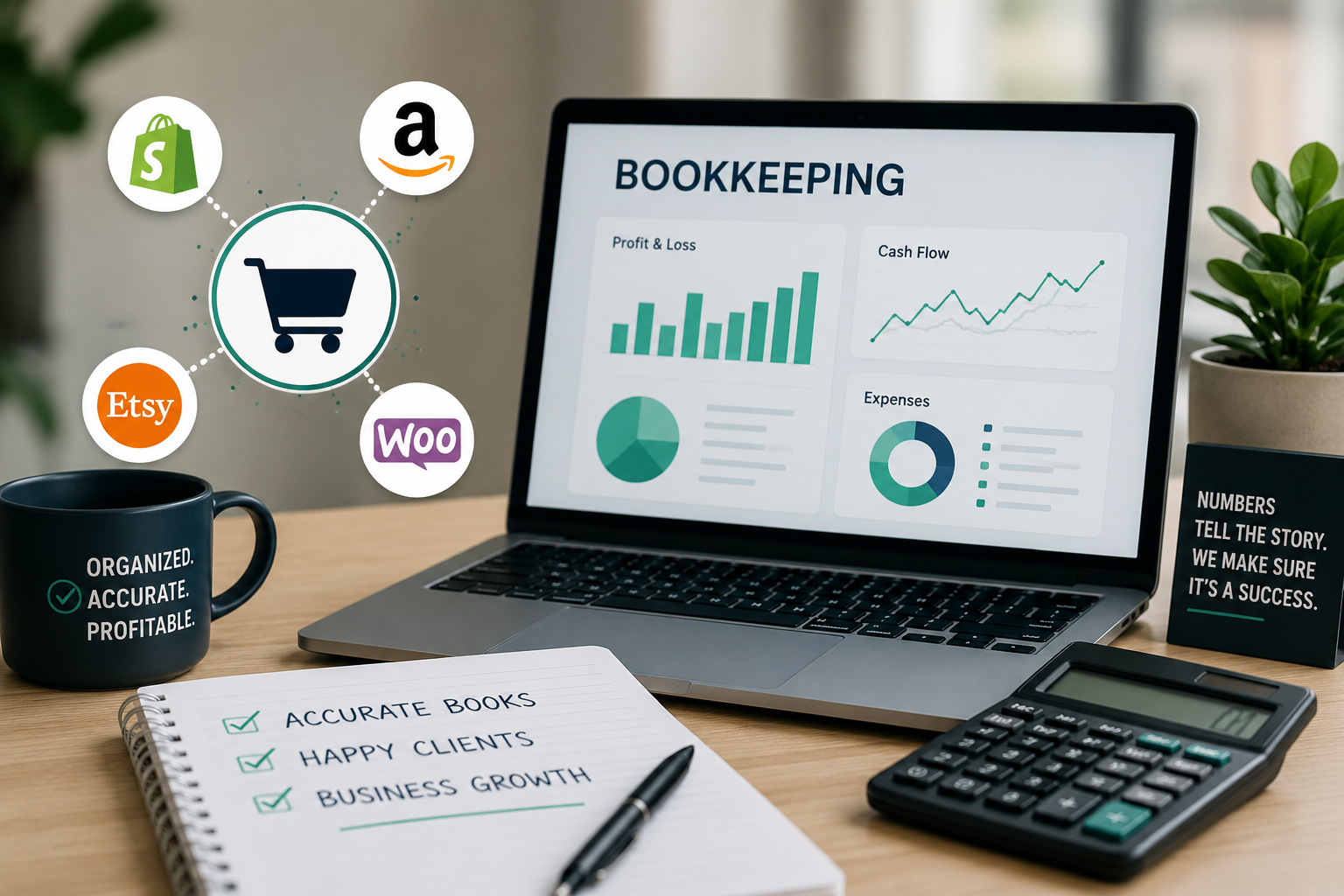
Starting a bookkeeping business is one of the most accessible paths to self-employment, with startup costs under $3,000, steady client demand, and cloud tools that let you operate from a laptop with the capabilities of a mid-sized firm. But easy to start isn’t the same as easy to succeed. Here’s the system that actually works.
What a Bookkeeping Business Actually Does
Most new bookkeepers think they’re selling data entry. They’re not. Clients buy peace of mind: no more dreading tax season, no more guessing at profitability, no more financial chaos.
This is especially true for e-commerce sellers. A Shopify store owner juggling multiple sales channels, inventory COGS, multi-state sales tax, and Amazon’s payout structure doesn’t need a generalist. They need someone who understands the specific chaos of e-commerce finance. Position yourself around that expertise and you’ll close faster, charge more, and retain clients longer.
Do you need credentials to start a bookkeeping business?
No degree is required, but credentials matter early because clients can’t evaluate your accuracy before hiring you.
Worth pursuing:
- QuickBooks ProAdvisor Certification — Free through QuickBooks Online Accountant. Two levels (core workflows + advisory skills). Getting listed in the ProAdvisor directory alone has generated first clients for hundreds of new bookkeepers. Start here.
- Intuit Academy Bookkeeping Certificate — ~30 hours via Coursera, free to audit, beginner-friendly.
- Certified Bookkeeper (CB) via AIPB — More rigorous, carries weight with corporate clients.
- Certified Public Bookkeeper (CPB) via NACPB — Solid mid-tier credential for US practitioners.
For most people, QuickBooks ProAdvisor is the highest-ROI first move free, fast, and e-commerce clients often request it as a baseline.
How to Choose a Niche for Your Bookkeeping Business
Generalists struggle. Specialists scale. Niching lets you charge more, market better, and close faster.
Best Niches for a Bookkeeping Business
E-commerce (Shopify, Amazon, Etsy, WooCommerce) — The most underserved bookkeeping niche. It involves inventory cost tracking, COGS reconciliation, multi-channel payment processing, platform fee deductions, and multi-state sales tax compliance. Most generalists can’t handle it. That gap is where pricing power lives. A growing e-commerce store typically needs $800–$1,800/month in bookkeeping support recurring revenue with strong retention because switching bookkeepers mid-year is genuinely painful for these sellers.
Other strong niches: real estate investors, restaurants, freelancers and digital agencies, and healthcare practices. If you’re building a virtual practice, e-commerce and digital businesses are the natural fit, remote-first by default, with no in-person meetings required.
How to Legally Start a Bookkeeping Business
- Sole Proprietorship — Simplest to start, but no liability protection. Fine temporarily; not ideal long-term.
- LLC — The default choice. Liability protection, clean personal/business separation, and pass-through taxes. Filing costs $50–$500 depending on state.
- S-Corp Election — Worth exploring once annual revenue clears $50K–$60K to reduce self-employment tax.
Other essentials:
- EIN — Free from the IRS, needed for business banking and client W-9s
- Business bank account — Non-negotiable. Mixing personal and business finances is the most common early mistake
- E&O Insurance — Errors and omissions coverage runs $400–$1,200/year; some larger clients require it
- Fidelity Bond — Low cost, high trust signal if clients give you account access
- DBA Registration — Required if operating under a name other than your legal name
Essential Tools and Software for Starting a Bookkeeping Business
Software isn’t just operational; it’s a marketing decision. Clients will ask what you use.
Accounting software:
- QuickBooks Online — Market standard. Know it well.
- Xero — Strong alternative, especially for multi-currency and e-commerce integrations
- Wave — Free, suitable only for very simple clients
Ecommerce-specific tools:
- A2X — The gold standard for e-commerce bookkeeping. Maps Shopify, Amazon, Etsy, and other platform payouts to QuickBooks or Xero automatically, splitting sales, fees, refunds, and taxes correctly. If you specialize in e-commerce, this becomes your differentiator.
- Avalara / TaxJar — Sales tax compliance automation across multiple states
- Katana, DEAR Systems — For clients with serious inventory management needs
Operations:
- TaxDome or Canopy — Client portals, engagement letters, document management
- Loom — Async video walkthroughs, faster than email for explaining discrepancies
- Calendly — Eliminates scheduling friction
- Notion or ClickUp — Internal workflow and project tracking
Budget $150–$400/month for a full stack. Build lean; add tools as complexity demands.
How Much Does It Cost to Start a Bookkeeping Business?
New bookkeepers default to hourly billing because it feels safe. It isn’t; it caps income and trains clients to think about time rather than value.
Three models:
- Monthly retainer — Fixed fee for defined scope. Most sustainable for both parties.
- Hourly — Best for one-off projects and cleanups. Rates: $40–$80/hour general, $75–$150/hour for specialized e-commerce work.
- Project-based — For catch-up bookkeeping, system migrations, or financial cleanups. Quote the total, not the hourly estimate.
2026 market rates:
| Client Type | Monthly Rate |
| Basic small business (<100 transactions) | $200–$400 |
| Growing small business (100–300 transactions) | $500–$900 |
| E-commerce multi-channel seller | $800–$1,800 |
| Mid-sized business with payroll + AR/AP | $2,000–$3,500 |
How to Price Your Bookkeeping Services for Maximum Profit
Build Starter, Growth, and Premium tiers instead of à la carte pricing. A starter e-commerce package might include monthly reconciliation and P&L delivery. Growth adds COGS tracking and quarterly sales tax reporting. Premium adds controller-level review and monthly strategy calls. Tiered packages simplify client decisions and naturally drive upsells.
How to Get Your First Bookkeeping Clients
Start with your existing network. Before building a website, talk to people you already know. Offer a reduced rate for one to two months in exchange for a testimonial. This is how most bookkeeping businesses actually get their first client.
QuickBooks ProAdvisor directory. Once certified, you get a searchable profile small business owners actively use. Complete it, add a headshot, and collect reviews early. Free, ongoing lead generation.
LinkedIn and Facebook groups. For e-commerce clients specifically: share useful content (common COGS mistakes, why Shopify analytics don’t match your bank account) in Shopify, Amazon FBA, and Etsy communities. Participate as a helpful expert, not a marketer. Referrals follow naturally.
Google Business Profile. Even for a fully virtual practice, a completed GBP with reviews improves local search visibility significantly.
Referral partnerships. Build relationships with two or three CPAs, tax preparers, or business attorneys. A simple mutual referral arrangement costs nothing and tends to self-sustain once it starts.
How to Run a Bookkeeping Business Online or From Home
Data security: Password manager (1Password or Bitwarden), two-factor authentication on every platform, and a client portal for document sharing, not email.
Onboarding: The first 30 days set the tone. Build a repeatable checklist: collect credentials, document account structure, identify cleanup needed, establish communication cadence, and get an engagement letter signed.
Monthly reporting: Deliver P&L and balance sheet within 7–10 days of month close, with a brief written summary of anything notable. Clients who understand their numbers stay clients longer.
Scope management: Define scope in writing before work begins. “Monthly bookkeeping” is vague. Reconciliation of up to 3 accounts, categorization of all transactions, P&L, and balance sheet by the 10th” is not. Scope creep causes more resentment in client relationships than almost anything else.
How to Scale a Bookkeeping Business Beyond a Solo Practice
A well-run solo practice with 10–15 clients at $500–$1,500/month generates $60K–$270K annually before expenses. That’s a complete business. But if growth is the goal:
- Systematize first. Document every process before hiring anyone. If the business depends on your memory, it doesn’t scale.
- Hire a part-time bookkeeper. $18–$25/hour for data entry and routine categorization frees your time for client relationships and business development.
- Expand services. Payroll, AP management, cash flow forecasting, and KPI reporting add recurring revenue to existing relationships without requiring new clients.
- Raise rates annually. 5–10% per year is standard. Give 60 days’ notice. Most clients stay.
Why Ecommerce Bookkeeping Is the Fastest-Growing Opportunity
Millions of Shopify sellers, Amazon FBA operators, and DTC brands are generating real revenue, often $100K–$2M+ annually, with financial blind spots that cost them money. Most are doing their own books badly, or not at all. Most general bookkeepers aren’t equipped to help them.
The specific problems e-commerce bookkeepers solve, like accurate COGS calculation, multi-state sales tax compliance, and reconciling payouts across Shopify Payments, Stripe, PayPal, and Amazon, aren’t impossible to learn. But they’re underserved. QuickBooks ProAdvisor certification, plus A2X proficiency, plus positioning language that speaks directly to Shopify or Amazon sellers, is a genuinely rare combination. It commands $1,000–$2,000+ per month per client.
Common Mistakes to Avoid When Starting a Bookkeeping Business
- Taking every client. A $200/month client who emails daily and disputes everything costs more than they pay. Qualify early.
- Skipping contracts. Every engagement needs a signed letter defining scope, payment terms, and exit provisions. This prevents most disputes before they start.
- Neglecting your own books. Set aside 25–30% of revenue for self-employment taxes from day one.
- Not collecting reviews. After the first three months with a satisfied client, ask for a Google review or LinkedIn recommendation. Five reviews on your GBP profile outperform a month of social media posts.
Start a Bookkeeping Business the Right Way
A bookkeeping business built on clear positioning, real credentials, solid processes, and well-chosen clients is one of the more resilient businesses you can run. The work is always needed. AI is changing data entry; it isn’t changing judgment, client relationships, or the value of someone who keeps a business’s financial house in order.
Start narrow. Serve that niche exceptionally well. Charge appropriately from day one. Underpricing isn’t humility; it’s a structural problem that only gets harder to fix over time.